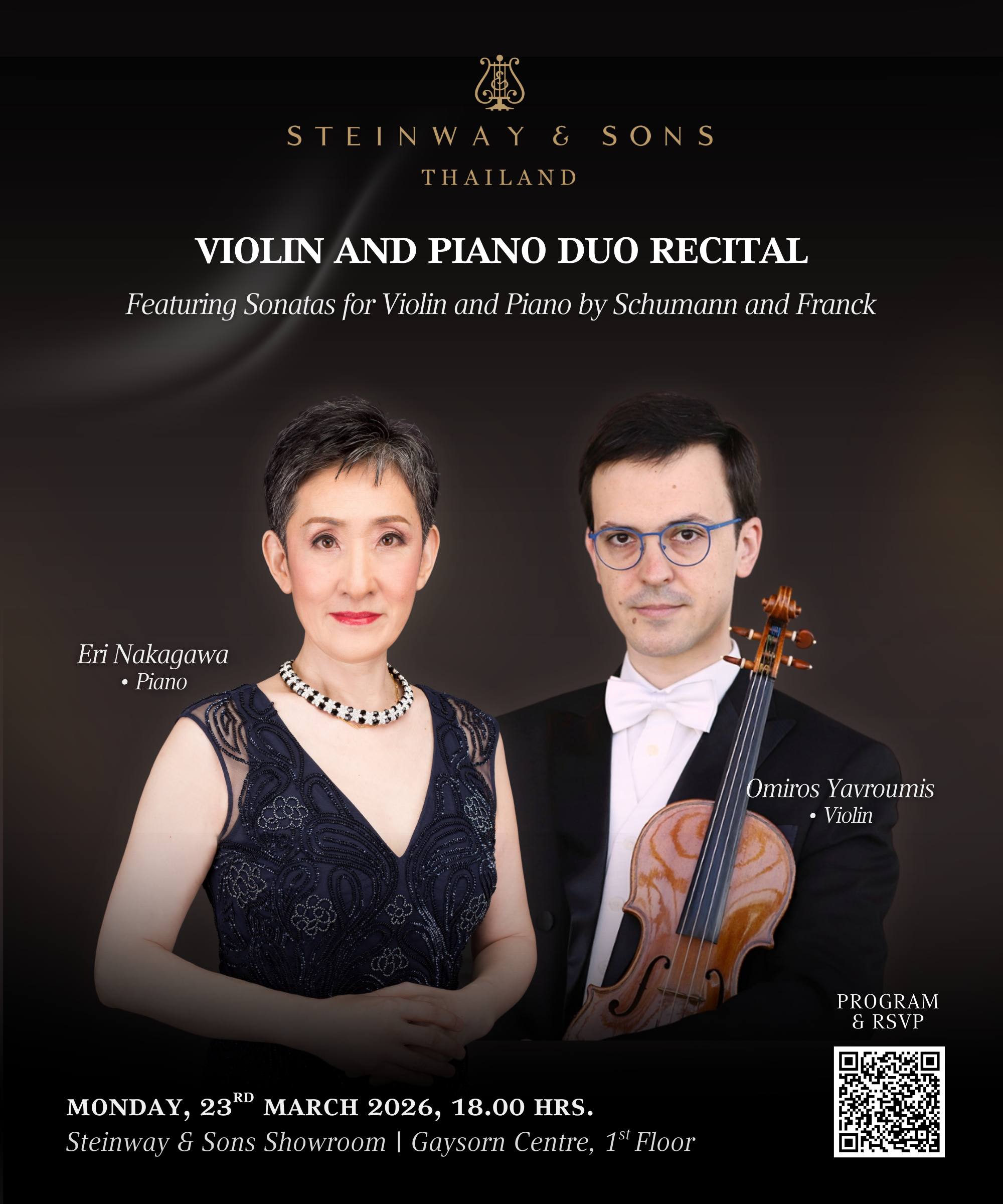
VIOLIN AND PIANO DUO RECITAL
by Omiros Yavroumis and Eri Nakagawa
23rd March 2026 | 18.00 hrs.
Steinway Thailand is delighted to host two distinguished musicians, Omiros Yavrouomis and Eri Nakagawa, for an intimate Violin and Piano Duo Recital.
Join us for an evening featuring a refined selection of masterworks, as the artists come together to present timeless masterpieces by César Franck and Robert Schumann.
prograM
Violin Sonata
No. 2 in D minor, Op. 121
I. Ziemlich langsam - Lebhaft
II. Sehr lebhaft
III. Leise, einfach
IV. Bewegt
Robert Schumann
(1810 - 1856)
(INTERMISSION)
Sonata in A major
for Violin and Piano
I. Allegretto ben moderato
II. Allegro
III. Ben moderato
IV. Allegretto poco mosso
César Franck
(1822 - 1890)
Two Pieces for Violin and Piano, Op. 6
I. Romance
II. Danse hongroise
Sergei Rachmaninoff
(1873 - 1943)
PROGRAM NOTE
Robert Schumann (1810–1856)
Violin Sonata No. 2 in D minor, Op. 121 (1851)
Schumann’s three sonatas for violin and piano were all composed between 1851 and 1853, only a few years before his death. Shortly after completing the First Violin Sonata in Düsseldorf between September 12 and 16, 1851, he began a second work for the same combination, written from October 26 to November 2 of that year. The sonata was dedicated to the violinist Ferdinand David (1810–1873), concertmaster of the Leipzig Gewandhaus Orchestra under Mendelssohn. Schumann and David shared a warm friendship that began through their circle in Leipzig. The sonata received its first public performance by Clara Schumann and Joseph Joachim in Düsseldorf on October 29, 1853.
While the First Sonata unfolds in three movements, the Second is cast in four and is broader in scope: more dramatic, more symphonic in conception, and charged with a restless intensity that foreshadows the emotional turbulence of Schumann’s final years. For much of its duration, the violin remains in its middle register, contributing to the work’s dark, concentrated sonority.
The opening movement begins with a majestic slow introduction. Schumann subtly embeds the dedication to David within the music itself: the first theme of the ensuing sonata-form movement opens with the notes D–A–F–D, a musical cipher derived from David’s name. This motif is launched with a stern, declamatory gesture that immediately establishes a mood of agitation. Rather than presenting a graceful violin melody supported by piano accompaniment, Schumann treats the two instruments as equal partners in a tightly woven dialogue. Syncopated figures in the piano act almost as a countermelody. The second theme begins in G minor before shifting to F major. Themes emerge in fragments, propelled by rhythmic insistence and harmonic tension; even moments of lyricism are shadowed by unease, giving the movement a sense of relentless striving.
The second movement, marked Lebhaft (very lively), is a scherzo in 6/8 time in B minor with two contrasting trios, suggesting a rondo-like design. The scherzo theme is driven with force by both violin and piano. The first trio, in F minor, introduces a darker color: the violin unfolds gently growling quadruplet figures over staccato piano writing. The second trio, notated with the violin in 2/4 meter, presents a repeated melody that alternates four measures in B minor with four in B major. A coda concludes the movement in B major with a bright, stately gesture that foreshadows the theme of the following movement.
The third movement, Leise, einfach (quietly, simply), in G major, presents a set of variations on the chorale melody Aus tiefer Not schrei ich zu dir (“From deep affliction I cry out to you”). The music shifts into triple meter and unfolds in four variations. It opens with gently haunting violin pizzicatos. The third variation recalls both the figuration and material of the scherzo, and its coda binds the middle movements even more closely, making them feel inextricably linked.
The final movement returns to sonata form. Its opening theme in D minor surges forward in perpetual motion, first stated in the piano and echoed by the violin. A transition introduces a new melody in the piano while the violin spins a sequence reminiscent of a Baroque concerto figure. The more lyrical second theme in F major provides welcome relief from the prevailing intensity. After a development that alternates contrapuntal treatments of the themes, the movement drives toward an extended coda in D major. Here the long struggle resolves into radiant affirmation, bringing the sonata to a magnificent and satisfying close.
César Franck (1822–1890)
Sonata in A major for Violin and Piano (1886)
César Franck’s Violin Sonata in A major is one of the great chamber works of the 19th century — a piece beloved for its warmth, lyricism, and deep emotional unity. Franck wrote the sonata in 1886 as a wedding gift for the Belgian violinist Eugène Ysaÿe, who sight-read it with the composer at the piano on the day of the wedding. Ysaÿe quickly adopted the piece into his repertoire, and it remains a cornerstone of violin literature today.
The sonata is a masterful example of cyclical form, a technique Franck favored in which themes return and transform across movements, creating a sense of organic wholeness. The motive that appears at the beginning of the work is used in various forms and shapes throughout the four movements. While maintaining this meticulous internal unity, each movement is richly varied and contrasting, and deeply emotional.
The opening movement begins quietly and tenderly, with the violin entering in a gentle, singing line over shimmering piano harmonies. This initial motive, imbued with mysticism, romance, and a profound hidden passion, perhaps represents the character of the entire piece. The character of each movement can also be understood as a development of different aspects of this motive.
The second movement, written in D minor, contrasts sharply. It is the most powerful and passionate movement of the entire work and is cast in sonata form. The first theme is introduced by the violin and then played in unison with the piano, pushing both instruments to symphonic intensity. The vivid contrast with the second theme — entrusted to the elegant and noble singing of the violin — is equally striking.
The third movement serves as a poetic interlude. Its free, improvisatory character resembles a recitative, as if the violin were speaking. Led by the piano’s flowing arpeggios, the violin unfolds one lyrical melody after another. This melody, which gradually builds in intensity, returns in the final movement.
This reflective passage prepares the way for the radiant finale, one of the most distinctive conclusions in chamber music. The final movement is written in rondo form. Violin and piano engage in a luminous canon — a musical dialogue in which each instrument echoes the other — creating a feeling of reconciliation and serenity. Earlier themes reappear transformed, and the sonata closes in a spirit of glowing affirmation.
Sergei Rachmaninoff (1873–1943)
Two Pieces for Violin and Piano, Op. 6 (1893)
Rachmaninoff composed his Op. 6 in 1893, at the age of twenty, during his final years at the Moscow Conservatory. These two short works — Romance and Danse hongroise — already show the young composer’s instinctive gift for melody and dramatic contrast. Though compact in scale, they reveal a striking maturity of expression and a flair for color that would become hallmarks of his later music.
The Romance unfolds in a dark, warm lyricism characteristic of Rachmaninoff’s early style. The violin sings a long, arching melody over the piano’s gently pulsing accompaniment, creating a mood of introspection and restrained passion. The harmony shifts with subtle richness, and the emotional intensity gradually expands toward a glowing central climax. A brief, rhapsodic violin cadenza — reminiscent of the exotic storytelling voice of Rimsky-Korsakov’s Scheherazade — adds a moment of improvisatory fantasy before the music recedes into a quiet, reflective close. Even at this early stage, Rachmaninoff demonstrates his extraordinary ability to sustain a vocal, almost operatic line.
The Danse Hongroise provides a vivid contrast. Inspired by the 19th-century fascination with Hungarian and “Gypsy” idioms, the piece bursts with rhythmic energy, sharp accents, and fiery virtuosity. The violin writing is brilliant and theatrical, alternating between playful swagger and explosive drive, while the piano part crackles with percussive vitality. Beneath the showmanship lies Rachmaninoff’s characteristic harmonic depth, lending the dance an edge of drama and tension.
PERFORMERS
Omiros Yavroumis, violin
Omiros Yavroumis graduated in 2002 from the Royal Academy of Music, London, earning both Bachelor’s and Master’s degrees. He also holds a degree in Musicology from the University of Athens, Greece.
A pupil of Nancy Bargerstock in Greece and Mateja Marinković in London, he has participated in masterclasses and studied with distinguished violinists including Ruggiero Ricci, Zakhar Bron, Lydia Mordkovitch, Leonidas Kavakos, Ivry Gitlis, Eric Friedman, Maurizio Fuks, Sylvia Rosenberg, and Grigory Zhislin. He has won numerous awards in both solo and chamber music competitions in Greece and internationally.
He has appeared as a soloist with the Thailand Philharmonic Orchestra, Jelenia Góra Philharmonic, Filharmonia Dolnośląska, State Orchestra of Athens, City of Thessaloniki Symphony Orchestra, City of Athens Symphony Orchestra, City of Volos Symphony Orchestra, and the Metropolitan Symphony Orchestra of Athens.
Internationally, he has performed in the USA, Australia, the United Kingdom, Germany, Austria, France, and Italy, collaborating with renowned conductors such as Sir Colin Davis, Sir Charles Mackerras, Esa-Pekka Salonen, Neeme Järvi, Kent Nagano, and Michael Tilson Thomas. He has performed in prestigious venues including the Sydney Opera House, Royal Festival Hall, Royal Opera House (London), and the Grosses Festspielhaus (Salzburg).
Since 2002, he has served as Concertmaster of the City of Thessaloniki Symphony Orchestra and, since 2004, of the Youth Symphony Orchestra of Kalamaria. In 2008, he was appointed Professor of Violin at the State Conservatory of Thessaloniki.
In 2011, he was selected as a member of the YouTube Symphony Orchestra and performed at the Sydney Opera House. In October 2014, he was appointed Concertmaster of the Metropolitan Symphony Orchestra of Athens, and since December 2016, he has served as Concertmaster of the Thailand Philharmonic Orchestra. His students have won prizes in national and international competitions and have been admitted to leading European music academies.
Eri Nakagawa, piano
Eri Nakagawa, a native of Osaka, Japan, has been a member of the piano faculty at the College of Music, Mahidol University, Thailand, since 1995. Previously, she served as Assistant Professor of Music Performance at Ball State University, Indiana, USA.
She has been invited as a guest pianist and professor at the University of Northern Colorado in USA, Bruckner Conservatory in Linz, Bösendorfer Saal in Vienna, Yong Siew Toh Conservatory of Music in Singapore, Corfu Festival in Greece, Western Australian Academy of Performing Arts in Perth, Moulin d’Andé International Masterclasses in Normandy, France, Piano Plus Festival in Corfu, Greece, UCSI University in Kuala Lumpur, Beijing China Conservatory, Northwest Minzu University in Lanzhou, NanJing Xiaozhuang University, Zhejiang Conservatory of Music in Hangzhou, Sicily International Piano Festival, etc. In addition to frequent solo recitals, she has performed over ten concertos with various orchestras and regularly collaborates with distinguished musicians in Thailand and abroad.
Dr. Nakagawa earned her degrees from Osaka Kyoiku University, Mukogawa Women’s University, and Ball State University, where she completed her Master’s and Doctoral degrees in piano performance. Her principal teachers include Koji Tanaka, Naoyuki Inoue, Mitchell Andrews, and Pia Sebastiani.
Her students have won top prizes in national and international competitions and have been accepted into prestigious institutions such as Juilliard, Mozarteum, and the Royal College of Music. She has received several honors, including the Trinity Guildhall Excellence in Music Education Awards (2010, 2017), Chopin Competition in Asia Outstanding Teacher Award (2013), Kawai Best Teacher Award (2016), and the Mahidol Music Honor Award (2022). She is also a frequent jury member at international piano competitions.
THE REGISTRATION FOR THIS EVENT IS CLOSED.
LOCATION
Steinway & Sons Showroom
#1F-04 Gaysorn Center, 1st Floor
999 Phloen Chit Rd., Lumpini, Bangkok